Showing posts with label milk coffee. Show all posts

Monday, March 14, 2022

Milk Coffee: How does dairy production affect human health?

In recent years, there has been a growing preference for alternative milk due to reasons related to the environment and health. However, this switch is not prominent enough as dairy production is still projected to grow by 1% per annum over the coming decades (OECD). 

Besides the atmospheric pollution caused by cow manure, an excessive use of antibiotics used in the dairy industry pollutes the products they produce. The intensive use of antibiotics was introduced by policymakers, to expand the dairy production (Clay, Garnett, & Lorimer, 2020) while keeping diseases in check (Sentient Media, 2019).
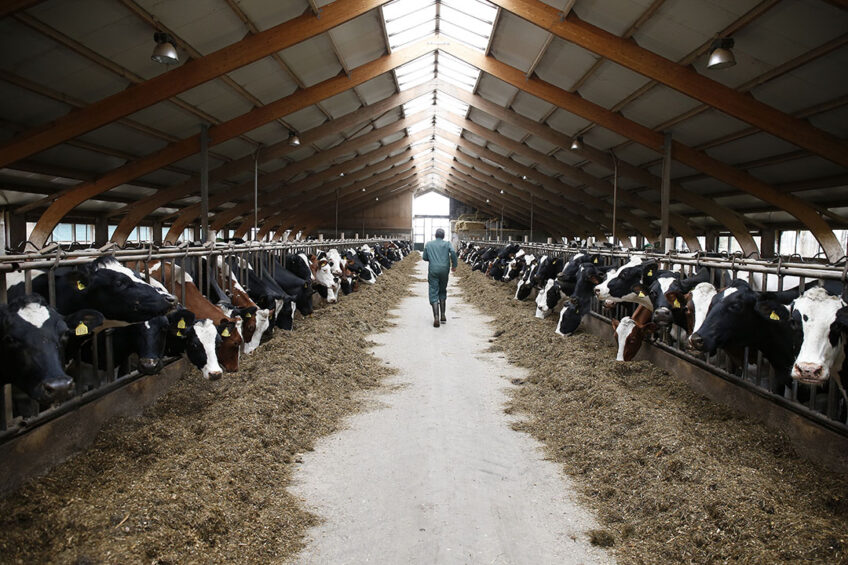
Image 1: Confinement feeding system. Cows are kept close to together which encourages the spread of diseases. Hence, antibiotics were used to prevent disease spreading. Imgae source: Dairy Global.

The use of antibiotics in dairy production is a global issue that affects both the developing and developed countries. While we generally view antibiotics to be helpful as we use them to fight off diseases when we are sick, the excessive and indiscriminate use of antibiotics for cows (particularly beta-lactum based antibiotics) have increased the resistance of microbes, posing problems to the human and animal health (Groot and Hooft, 2016).

Groot and Hooft also adds that when antibiotics leak into the soils and waters, it inhibits the growth of useful bacteria that denitrifies the nitrates (NO3-), contributing to the acidification of soils and waters. This threatens the sustainability of plant and animal health that depend on the said mediums for survival.

An example of a type of the antibiotics - cephalosporin - is found to be particularly persistent in the environment, as it requires high temperatures and light to degrade (Das et al., 2019), suggesting that cephalosporin can terrorise the balance of the microbial ecosystem for a long time. This is especially so in countries without proper waste treatment facilities as well.

Fortunately, some governments, in countries like the Netherlands and the U.S, have realised the detriments of the excessive antibiotics use and placed are actively regulating such chemicals in the dairy and agricultural industry. 

While regulations by the state can help in cushioning the impacts of excess antibiotics leaking into the environment, we can also do our part in reducing dairy demand or switching to organic dairy options instead. Perhaps, with our collective efforts, we can reduce the scale of antibiotics pollution in the environment, starting with the dairy industry.

Thursday, March 3, 2022

Milk Coffee: Almond milk

People in different countries tend to be more receptive towards different alternative milk, and as such, we focus on North America, as almond milk has dominated the plant-based milk market, by accumulating  63% of the market share (Young, 2021). We seek to answer the question: what are the factors that contribute to pollution during almond milk production, and to what extent are they damaging to the environment.

In a report by Simar (2020), he summarised the production process of almond milk in the US:

Stage

Source

Extent of pollution (annual)

Production

Fertilizers

-          83.7 pounds of carbon monoxide (CO)

-          59.5 pounds of ammonia (NH3)

-          74.9 pounds of nitrogen oxide (NO)

-          2.2 pounds of particulate matter (PM)

Pesticides

Chemicals used depend on farm and operating scale

Processing

Harvesting machines

Greenhouse gases and leakages depend on farm and operating scale

Almond shell cracking machine

Electricity source depends on farm and operating scale

After production

Transportation

(semi-trucks)

-          286.6 pounds of CO

-          163.1 pounds of NO

-          2.2 pounds of PM10

-          6.6 pounds of PM2.5

Packaging

Amount of plastic depends on farm

Agricultural waste

-          24.3 pounds of CO

-          2.2 pounds of NO

-          4.4 pounds of PM2.5


Simar's findings suggest that the after production of almond milk is the most pollutive, as transportation, plastic, and agricultural waste generate the greatest amounts of pollutants.

Beyond the numbers, pollution from after production also occurs globally.

Firstly, besides transportation by trucks, the milk by sea as countries export them to the global markets. According to the International Maritime Organisation, shipping accounts for 1.056 million tonnes of carbon dioxide being released, and these amounts of gases are spread across the oceans and trapped within the atmosphere. Hence, contributing to global warming on a global scale.

Secondly, the ill-disposed plastic packaging may end up within the oceans, and be swept by the currents across the globe. Besides harming the animals physically when they mistake the plastics for food, some plastics that are degraded into microplastics can be consumed by the marine life, and be bioaccumulated and biomagnified. This eventually returns to harm human health when we consume seafood.

Lastly, the chemical leaches into the soil and can contaminate groundwater storage. On a regional scale, humans who depend on groundwater storage may experience health issues. On a global scale, agricultural waste can be transported by fish and physical elements and cause problems to health as well (Nagendran, 2011).

Alas, while almond milk can cause global-scale pollution, it is still more sustainable compared to dairy milk, as its primary and processing stages of production are less pollutive. Soucing locally produced alternative milk can further reduce our pollution footprint. However, sourcing local poses a problem for land-scarce countries like Singapore, as converting land to produce primary products incur high opportunity costs. What then can an alternative solution be?

Monday, February 28, 2022

Milk Coffee: Oat milk

Dairy milk tends to be the default option for white coffees. However, in 2019, there has been a 37% decrease in dairy milk consumers since the 1970s (Held, 2020), suggesting the rise in awareness of alternative milk options. Specifically, oat milk has been gaining increasing attention in the cafe scene due to its superior taste and texture against other alternatives. Sales of oat milk have risen 71% in just a year, from 2017 to 2018 (Aydar, Tutuncu, & Ozcelik, 2020). This poses the question: are there ramifications as consumers switch from dairy to oat?

Based on Poore and Nemecek's (2018) study conducted in 2013, oat milk uses significantly less land for production as compared to dairy, suggesting that the area for non-point source pollution via fertilizers and greenhouse gas emissions will be lower.

Figure 1: Environmental footprints of dairy and alternative milk. The data is based on Poore and Nemecek's study. Source: Ritchie, 2022.

This was supported by Roos, Patel, and Spangberg (2016), who did a more comprehensive study on oat milk production's impacts on the climate. Their study found that there is a 16-41% lower direct greenhouse gases emissions from energy and fertilizers usage, and the absence of livestock cultivation. However, the risk of eutrophication between oat and dairy milk appears to be similar given the same amount of land cultivated. Additionally, as oats are made of organic matter, the necessary process of digestion of oats by the enzymes produces 21-37% more ammonia emissions than dairy milk productions during storage and distribution. This increases the ecotoxicity impact on the environment. Fortunately, the ecotoxicity impact from oat milk production can be mitigated via the cultivation of grass-clover. This is difficult for dairy production as cows are ungulates and their hooves will compact the vegetation when they graze the fields, and barns limit the amount of space available for vegetation.

Overall, it seems that oat milk production is indeed a better alternative for the environment as compared to dairy milk, as lesser land can be used to produce the same amount of both kinds of milk. This means that oat milk generates fewer emissions and pollution risks than dairy milk. 

Also, those who enjoy specialty coffee, but are constrained by dietary restrictions, should definitely consider oat milk as its flavour is not overpowering, and it does not coagulate as compared to other alternative milk. Giving the coffee a better taste and smoother texture.

Friday, February 25, 2022

Milk Coffee: The heart of pollution in the dairy industry

Regardless if it is a flat white, latte, cappuccino, or a kopi-C, kopi, 3-in-1, what is are the two ingredients that are common in both drinks? Coffee, and milk. As I have drilled on continuously about the causes of pollution in the coffee industry, I would now diverge to a complementary product to coffee. Milk.

According to Dr. Weiss, nitrogen forms bulk of a cow's diet, and only about 33% of the nitrogen intake retains in the cow's system or secreted as milk. The remaining 67% gets excreted as manure. Due to the high nitrogen content emitted, manure was found to be the primary cause of pollution in the dairy industry.

Manure can pollute the atmosphere as it releases ammonia, which can react with other pollutants in the air to form NH4+. NH4+ compounds contain aerosols which are harmful to our respiratory systems, and contributes to global warming. They can also travel long distances, which increases the expands the area of vulnerability to a global scale. (source). However, the volatility of ammonia in the atmosphere depends on the:

-   surface area
-   air movement
-   temperature
-   pH

of the manure (Weiss). Hence, while the ammonia released into the atmosphere via manure is pollutive, complex conditions need to be satisfied for atmospheric pollution via ammonia to be considered as serious.

Besides polluting the atmosphere, manure releases ammonia which pollutes the hydrosphere too. Grossman (2014) quotes the EPA, who found that a cow can generate almost 25 times as much nitrogen form manure as humans can from sewage. This is concerning as the nitrogen either leaches into the soils, which gets incorporated in the waters, or it is directly disposed of in the waters. Nitrogen is a highly potent pollutant in waters as it is a limiting nutrient. In other words, it controls the growth of organisms in water bodies as there are other reactants in the waters that are more abundant. Excess nitrogen in waters can promote the growth of cyanobacteria and algae, which creates anoxic environments in the water bodies, threatening the aquatic life.

Hence, as the dairy industry contributes expansively to pollution, is it perhaps time to consider milk alternatives?

Milk Coffee: Our carbon footprint

There are many ways to prepare coffee at home. Drip bag, capsules, from a packet or pre-packed. They all taste different, but taste is not the only differentiating factor. Each choice has a different carbon footprint as well. 

A study conducted by the Department of Environment Quality in the state of Oregon compiled four different pieces of research that estimated the carbon footprint derived from the different preparations of coffee. The simplified version is of the following:


Image source: Heller, 2017.

From the study, it appears that milk-based coffee contributes the highest carbon footprint of about 0.22 to 0.24 kg of carbon dioxide equivalent per serving. As we know, milk comes from cows, and cultivating them contributes high levels of carbon emissions.

These emissions come from the clearing of land to cultivate the crops needed to feed the cows, and the cows themselves. It was found that cows are responsible for 15% of all anthropogenic greenhouse gas emission (Bryce, 2020)!

As we know, the clearing of land reduces carbon sinks, and the increase in dairy productions increases the carbon emitted and hence trapped in the atmosphere for at least 300 years. Alas, black coffee is not a perfect subtitute for milk coffee. This suggests that dairy production will stay, and if nothing is done, the existing atmospheric pollution will only worsen.

Hence, the question that remains is: how can we reduce our carbon footprint, besides switching from a cafe latte to an americano? 

Coffee to Go: Single use plastic straws

Guilty of using plastic straws for your chilled coffee? Even if you are not, many others are. Single-use plastic straws were found to be the...