Showing posts with label causes. Show all posts

Monday, March 14, 2022

Milk Coffee: How does dairy production affect human health?

In recent years, there has been a growing preference for alternative milk due to reasons related to the environment and health. However, this switch is not prominent enough as dairy production is still projected to grow by 1% per annum over the coming decades (OECD). 

Besides the atmospheric pollution caused by cow manure, an excessive use of antibiotics used in the dairy industry pollutes the products they produce. The intensive use of antibiotics was introduced by policymakers, to expand the dairy production (Clay, Garnett, & Lorimer, 2020) while keeping diseases in check (Sentient Media, 2019).
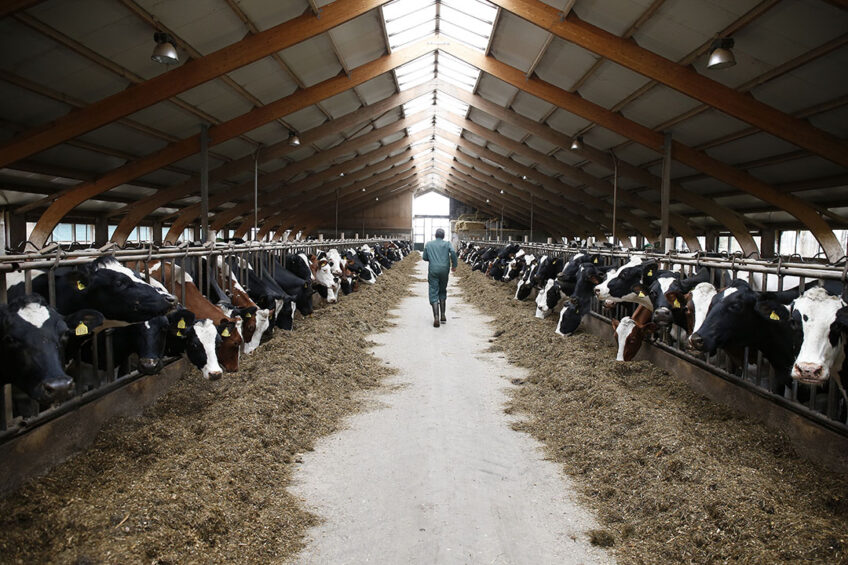
Image 1: Confinement feeding system. Cows are kept close to together which encourages the spread of diseases. Hence, antibiotics were used to prevent disease spreading. Imgae source: Dairy Global.

The use of antibiotics in dairy production is a global issue that affects both the developing and developed countries. While we generally view antibiotics to be helpful as we use them to fight off diseases when we are sick, the excessive and indiscriminate use of antibiotics for cows (particularly beta-lactum based antibiotics) have increased the resistance of microbes, posing problems to the human and animal health (Groot and Hooft, 2016).

Groot and Hooft also adds that when antibiotics leak into the soils and waters, it inhibits the growth of useful bacteria that denitrifies the nitrates (NO3-), contributing to the acidification of soils and waters. This threatens the sustainability of plant and animal health that depend on the said mediums for survival.

An example of a type of the antibiotics - cephalosporin - is found to be particularly persistent in the environment, as it requires high temperatures and light to degrade (Das et al., 2019), suggesting that cephalosporin can terrorise the balance of the microbial ecosystem for a long time. This is especially so in countries without proper waste treatment facilities as well.

Fortunately, some governments, in countries like the Netherlands and the U.S, have realised the detriments of the excessive antibiotics use and placed are actively regulating such chemicals in the dairy and agricultural industry. 

While regulations by the state can help in cushioning the impacts of excess antibiotics leaking into the environment, we can also do our part in reducing dairy demand or switching to organic dairy options instead. Perhaps, with our collective efforts, we can reduce the scale of antibiotics pollution in the environment, starting with the dairy industry.

Saturday, March 12, 2022

Coffee Farming: What is preventing farmers from cultivating coffee crops sustainably?

Coffee crops are widely produced along the coffee belt due to their lucrativeness and the high demand for coffee beans worldwide. While the mention of coffee brings big brands like Starbucks and Nescafe to mind, did you know that majority of the beans are produced by smallholders? 

According to Akenroye et al. (2022), there are, overwhelmingly, 21 factors that hinder smallholders from achieving sustainability (some are similar and thus combined into the following list):

Figure 1: List of factors hindering smallholders from achieving sustainability. 

Figure 2: Count of the factors derived from figure 1.

Within these factors, financial constraints seem the most obvious problem that discourages sustainable farming methods. This is not surprising as smallholders are at the bottom of the coffee production chain, which means that the primary products they produce are worth less than what secondary or tertiary producers produce. It would hence be unfair to the smallholders to adopt organic farming methods as they have to shoulder most of the burden of the high certification costs and manual labour involved. 

Sure, some say that consumers are willing to pay a higher premium in support of organically grown coffee. However, Naegele (2019) found that the premiums paid are not proportionate to the quantity and cost involved in the production process. Furthermore, with the unpredictable elasticity of coffee, farmers are not advised to raise their bean prices too high so as to protect their profits (Wienhold, 2021). Therefore, it is perhaps more favourable for large firms with supernormal profits to chip in, in order to promote sustainable farming practices. 

Some ways firms could chip in are to absorb some of the high costs that accompanies the organic certifications, impart knowledge on organic agricultural methods, and engage in research and development for more sustainable and less labour intensive ways of cultivating reasonably yield crops.
While these methods may lower profits earned by the firms, in a circular economy, what goes around comes around. By helping smallholders adopt sustainable practices as part of their corporate social responsibility, firms may eventually benefit from higher sales as consumers tend to support brands they resonate with (Hsu & Bui, 2022).

Overall, as the lack of access to sufficient finance is one of the main causes of unsustainable agricultural practices, big firms should consider aiding smallholders in their cultivation process. In the long run, this could be useful to reduce the soil, water and atmospheric pollution caused by coffee farming.

Monday, March 7, 2022

Coffee at Home: Packaging beans

People who prepare their coffee from the beans usually get them prepackaged in a bag. Different brands of coffee sell their prepacked beans in different kinds of bags, ranging from plastic to paper. These packages attribute only about 3% of the coffee industry's carbon footprint (Fornero, 2020), and as such its impacts on the environment are less discussed than the other pollutive processes in the industry.
According to a study by Salomone (2003), packaging contributes negligibly to greenhouse gases emissions, ecotoxicity, and ozone layer depletion. This suggests that attention on packaging used in the coffee industry is not the main concern when dealing with environmental impacts. While true that there are bigger pollutants in the coffee industry, unsustainable packaging has been forefronted by many climate change activists, making the topic of sustainable packaging relevant in today's context. 

The problem of packaging is similar to that of coffee cups, which was previously discussed. The ambiguous and misleading logos indicating that the packages are recyclable are just not helping consumers to understand the proper means of recycling. Many times, packages containing beans would be made of two or more materials. This would mean that for effective recycling, materials must be separated, else, it would be as good as throwing them into the landfills.

While some may argue that there are biodegradable packaging available, it is found that only up to 60% of materials from such packages can biodegrade (Fornero, 2020). However, depending on the materials, the remaining 40% can be recycled in their corresponding bins. In this sense, biodegradable packaging seems like a favourable alternative to recyclable bags. However, to really reap the benefits of such packages, people have to step up and play their part in recycling. This seems difficult as recycling rates in many countries fall below 50%, suggesting that the non-biodegradables are highly likely to end up in landfills.

To conclude, coffee packaging contributes little to the pollution brought about by the coffee industry. However, that should not be a reason to ignore the problem as a little bit of pollution goes a long way, especially when we consider the size of the industry. While 'biodegradable' packaging is currently the most sustainable packaging available, consumers have to start recycling properly to reap the full benefits of such packages.

Friday, February 25, 2022

Milk Coffee: The heart of pollution in the dairy industry

Regardless if it is a flat white, latte, cappuccino, or a kopi-C, kopi, 3-in-1, what is are the two ingredients that are common in both drinks? Coffee, and milk. As I have drilled on continuously about the causes of pollution in the coffee industry, I would now diverge to a complementary product to coffee. Milk.

According to Dr. Weiss, nitrogen forms bulk of a cow's diet, and only about 33% of the nitrogen intake retains in the cow's system or secreted as milk. The remaining 67% gets excreted as manure. Due to the high nitrogen content emitted, manure was found to be the primary cause of pollution in the dairy industry.

Manure can pollute the atmosphere as it releases ammonia, which can react with other pollutants in the air to form NH4+. NH4+ compounds contain aerosols which are harmful to our respiratory systems, and contributes to global warming. They can also travel long distances, which increases the expands the area of vulnerability to a global scale. (source). However, the volatility of ammonia in the atmosphere depends on the:

-   surface area
-   air movement
-   temperature
-   pH

of the manure (Weiss). Hence, while the ammonia released into the atmosphere via manure is pollutive, complex conditions need to be satisfied for atmospheric pollution via ammonia to be considered as serious.

Besides polluting the atmosphere, manure releases ammonia which pollutes the hydrosphere too. Grossman (2014) quotes the EPA, who found that a cow can generate almost 25 times as much nitrogen form manure as humans can from sewage. This is concerning as the nitrogen either leaches into the soils, which gets incorporated in the waters, or it is directly disposed of in the waters. Nitrogen is a highly potent pollutant in waters as it is a limiting nutrient. In other words, it controls the growth of organisms in water bodies as there are other reactants in the waters that are more abundant. Excess nitrogen in waters can promote the growth of cyanobacteria and algae, which creates anoxic environments in the water bodies, threatening the aquatic life.

Hence, as the dairy industry contributes expansively to pollution, is it perhaps time to consider milk alternatives?

Saturday, February 19, 2022

Coffee at Home: Are coffee pods problematic?

Since the popularisation of Nespresso coffee pods in 1988, coffee consumers have had the luxury and convenience to enjoy a cup of coffee almost instantly and comfortably in their homes. Despite the proliferation of coffee pods from alternative brands following the loss of Nespresso's coffee pod patent, Nespresso pods remain the go-to for coffee pod consumers. However, Nespresso pods are coming under scrutiny in the 21st century, as there has been a growing awareness that the excessive use of coffee pods are polluting the environment, with many of them ending up in landfills instead of proper recycling facilities (Grant, 2020). 
Figure 1: Nespresso pods end up in landfills as they are improperly disposed of. Image source: Huntsdale, 2019.

This is a shame as Moskvitch (2019), who corroborated the finding of different researches, found that coffee pods are made of materials that are highly recyclable. The Nespresso pod, for instance, is made primarily of aluminium, which is a metal that can be easily melted and reused repeated. The catch for Nespresso pods is that they contain a silicon layer, which requires specific technologies to remove before recycling can take place. As such, consumers using Nespresso pods are required to return the pods back to Nespresso's collection points, should they wish to recycle.

Expectedly, recycling rates are low. In 2018, in the UK alone, 42% of coffee pod users throw the pods away after use. This is in spite of Nespresso's efforts to expand its recycling efforts to reach 100% recycling rates by 2020 (the goal was not achieved), by increasing its global capsule recycling points (Grant, 2020). Evidently, besides making the recycling facilities convenient to consumers, awareness of such facilities must also be strengthened. Additionally, while Nespresso wishes to define their capsules through the silicon layer embedded in their capsules (Moskvitch, 2019), removing the silicon would make the capsules more recycle-friendly, as typical recycling plants will then have the capacity to recycle these pods.

In essence, to improve recycling rates and reduce pollution of Nespresso coffee pods, the mindsets of both consumers and the Nespresso company need to change. Consumers have to be more active in recycling, and Nespresso needs to forgo its ego so that its coffee pods can be easily recycled.

Friday, February 11, 2022

Coffee to Go: Bring your own tumbler

Previously, through James Hoffman's video, we peeked into the impact that paper cups can have on our environment should we dispose of them improperly. In his video, he commented on the different alternatives to paper cups, such as bringing our own tumblers, and using porcelain or biodegradable cups. However, he also implied that it is our habits that must change, should we desire a positive and substantial impact. While that is undoubtedly true, I am curious about the public's willingness to adopt a greener lifestyle by switching to reusable cups instead of paper when they takeaway coffee.

Working in a café, I have served many takeaway coffees. While there are customers who bring their own tumblers on a regular basis, many times, paper cups is the default choice. The café where I worked started selling reusable cups a year ago, and there were some customers who bought it, perhaps in their attempt to go green. I remember that there was this regular customer who asked if she could leave her tumbler in our café and we use it every time she takes out coffee. We agreed, and this positive change happened for at least a month or two. Alas, she came back without her tumbler, and we returned to serving her coffee in paper cups.

This is not a unique case as Lee (2015) behavioral studies found that among the 100 people he surveyed, 84% knew about the pollution that paper cups can bring to the environment, but only 33% bothered to use their own tumblers. The prevailing reasons for not using tumblers are inconvenience and that uneconomical. This suggests that there is a pressing need to change people's perspective of tumblers, as in a circular economy, every paper cup we throw away, comes back to us in a negative way.

How then can we change this reliance on paper cups? Song, Lee and Jung (2020) proposes that strategies can adopt a 'default option' and 'bandwagon effect' approach to change consumers' behaviors. This will be further explored in the next post.

Wednesday, February 9, 2022

Coffee to Go: Are we really recycling?

Paper cups have been widely used in coffee shops and cafes to take hot drinks away and drink on the go. It is estimated that 16 billion cups are thrown away globally per year, which wastes 6.5 million trees and 4 billion gallons of water annually (from Greenmatch). In the video below, James Hoffman talks about the necessity for paper cups in the coffee industry, while cautioning viewers of the dangers when we over-rely on them.

To summarise the video, some key takeaways are:

  • Proper disposal methods are needed to remove the plastic lining within the paper cup before recycling. 
  • Recycling companies without the capacity to remove the linings throw the paper cups into landfills.
  • The UK government proposes to reduce paper cup usage via a "latte levy", where takeaways coffees are charged an extra 25 pence
  • Suggested alternatives to paper cups are porcelain cups, reusable cups (tumblers), and biodegradables. However, these alternatives are plagued with their own problems.
The first two points are the most interesting. Paper cup manufacturers are indirectly contributing to pollution when they print recyclable signs on the cups, as the signs are misleading for consumers, and retarding the recycling system. Paper cup manufacturers seem to be green-washing their cups, as they do not explain the conditions to meet before the cups can be recycled. Consumers then feel environmentally responsible when they throw their used paper cups into the recyling bins. When improperly disposed, the paper cups in the bins, can contaminate the recyclables, stripping away their potential to be recycled. Eventually, these wastes end up in landfills, which generate heaps of methane that pollute the atmosphere. As such, the lack of consumers' knowledge and the lack of manufacturers' initiative to educate results in a positive feedback loop of atmospheric pollution, due to the additional methane produced from waste that could be recycled.


Wednesday, January 19, 2022

Coffee Farming: A global concern

Will more be merrier? Not in the case of Vietnam's coffee plantations. Smallholders in Vietnam have been expanding their plantations for higher profits since the coffee commodity boom in the 1990s (from Hall et al., 2011). Such expansion constituting mega-projects has impacts on the global scale. Hence, we will be broadening our lenses to understand the global impacts of Vietnam's coffee mega-plantations.

Mega-plantations (from Miles and Noboru, 2019) is a concept involving the conversion of large acres of land for the farming of cash crops. This concept (according to Hall et al.) is demonstrated in Vietnam, as smallholders were eager to reap the high profits tagged to the coffee beans. Besides profits, the expansion of farmlands were also driven by unsuitable soil conditions as mentioned in the previous post. Consequently, large-scale deforestation took place, replacing 19% of  Vietnam's forest (from D’haeze et al, 2005), and releasing tonnes of sequestered carbon into the atmosphere as carbon dioxide, causing air pollution globally.

Over 1.1 million hectares of degraded agricultural land in Central Highlands, Vietnam. Image by: Nongnghiep, 2020


In addition to mega-plantations, the productivity levels of coffee trees play a subsidary role in contributing to the abovementionned air pollution. Typically, coffee trees only maintain their productivity for 15 to 25 years. Within this timeframe, factors like deteriorating soil conditions and  water availability concerns may force smallholders to replant their farmlands or abandon it (from Scherr et al., 2015), resulting in the release of carbon, polluting the atmosphere.

Farmer struggling with drought conditions. Image by: Communicaffe, 2016

While skeptics may claim that carbon dioxide is not a pollutant, they are partially right. Carbon dioxide can be categorised as naturally occuring or man-made. Only the carbon dioxide that exist as a result of human activities is considered a pollutant, as it negatively affects the environment and humans via the global warming phenomenon, resulting in undesirable circumstances like extreme weather conditions and impairment of human respiratory health (from Sciencing, 2021).

This second part of the Coffee Farming series explored how the conversion of coffee farms to mega-plantations in Vietnam, and the productivity cycle of coffee trees can cause air pollution, which contributes to the global warming effect. In the last Coffee Farming installment, we will explore the existing measures in place to reduce pollution in coffee plantations.

Sunday, January 16, 2022

Coffee Farming: Problems stemming from localized pollution

Coffee is one of the most consumed drinks in the world. According to Statista, there is a 13% increase in coffee consumed worldwide in the past five years, and just last year, more than 9 billion kilograms of coffee had been consumed. While consumers mostly benefit from the coffee industry, producers of coffee beans are often at the losing end, as they suffer different damages that accompany coffee production (from Chanakya and Alwis, 2004UNEP, 2021). Hence in this first installment of the Coffee Farming series, I would be investigating the damages experienced by the local coffee plantation workers in Vietnam, as a result of pollution during farming.


This week, we will be discussing the origins of kopi - a traditional cup of coffee that many Singaporeans recognize. As such, we will focus on Vietnam's coffee plantations, which is the largest producer of robusta beans that is essential to a cup of kopi


According to the United Nations Environment Programme (UNEP), about 80-90% of the robusta beans are produced by multiple smallholders, with the main goal of turning high yields of coffee cherries into profits. The prevalence of unfavourable soil conditions, however, inhibited the smallholders from achieving their goals. While the article aptly identified several causes for the poor soil conditions, emphasis ought to be placed on the smallholders’ lack of agricultural knowledge, which resulted in overfertilization of soils, and hence the low cherry yields. Fertilizers mainly consist of nitrogen and phosphorus, which are known to promote plant growth. As such, it seems justified that farmers associate more fertilizers with higher cherry yields. However, overfertilization causes these nutrients to leach into and pollute the soils, causing the land to be less fertile. This kickstarts a negative feedback loop, as unknowing farmers continue fertilizing the lands in hopes of higher yield. Besides soil pollution, excess nutrients may dissolve and contaminate the waters, endangering people's health and contributing to the 150 million USD damage to the economy. Hence, education on agricultural techniques is essential to prevent further damages on the regional scale.


This first of the Coffee Farming series briefly explored how ignorance towards farming techniques can lead to regional soil and water pollution, which negatively affects the farmers, the people, and the economy in Vietnam. In the next post, we will explore how the farms cause pollution on a global scale, so stay tuned!

Coffee to Go: Single use plastic straws

Guilty of using plastic straws for your chilled coffee? Even if you are not, many others are. Single-use plastic straws were found to be the...